
Summary
The Slate Truck is an American-made electric pickup truck introduced in 2025 by Slate, a company founded in 2022 as a division of Re:Build Manufacturing and headquartered in Troy, Michigan. Notable for its minimalist, utilitarian design, the Slate Truck emphasizes affordability and durability, starting at a base price of $24,950, making it one of the least expensive electric trucks on the market. Its innovative design allows conversion from a two-seat pickup into a five-seat SUV through modular components, targeting budget-conscious consumers seeking practicality over advanced technological features.
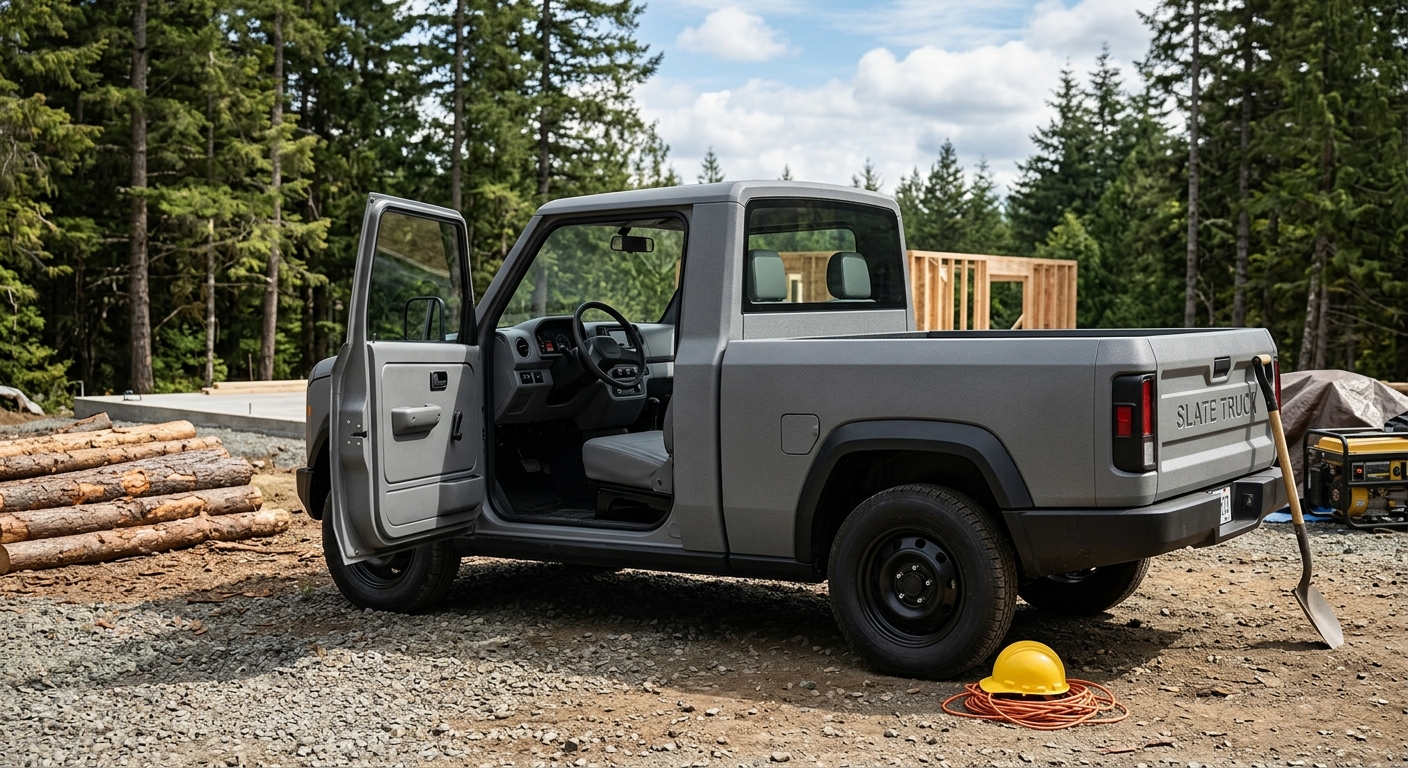
Slate’s design philosophy challenges conventional electric vehicle trends by prioritizing essential functionality over digital interfaces and luxury amenities. The truck features manual controls such as hand-crank windows and a spartan interior, combined with durable exterior panels made from a custom polypropylene-and-talc composite that resists dents and impact damage. This minimalist approach appeals to buyers interested in a rugged, work-ready vehicle that values ease of repair and user customization, distinguishing it from feature-heavy competitors.
Technically, the Slate Truck is powered by a rear-wheel-drive electric motor delivering 201 horsepower and offers multiple battery options, including a lithium iron phosphate (LFP) pack that extends its driving range up to approximately 205 miles. It supports various charging standards, including Tesla’s Supercharger network, and achieves modest performance metrics suitable for everyday use, with towing and payload capacities geared toward light-duty applications. The truck also incorporates standard safety features designed to meet high crash safety ratings despite its minimalist build.
The Slate Truck has generated attention for redefining electric pickup design through its “bare-bones” ethos amid a competitive market dominated by technologically advanced rivals like Tesla and Rivian. While its low price and modularity address an underserved market segment, the company faces challenges including potential changes to federal EV incentives and skepticism over the practical appeal of extreme minimalism. Nonetheless, Slate’s approach contributes to ongoing diversification in the electric vehicle sector, emphasizing affordability, durability, and user empowerment.
Background
Slate was founded in 2022 as a project within Re:Build Manufacturing, initially named “Re:Car.” The company operates out of Troy, Michigan, and was established by co-founders and co-chairmen Miles Arnone, William Barker, and Jeff Wilke, who also hold leadership roles at Re:Build Manufacturing. Slate’s investor base includes prominent figures such as Jeff Bezos and Mark Walter, alongside Re:Build Manufacturing itself.
The company remained in stealth mode until unveiling the Slate Truck on April 24, 2025. The Slate Truck is an American-made electric pickup designed with versatility in mind—it can be converted into an SUV to suit different needs. Positioned as an affordable electric vehicle, the truck starts at $24,950, making it the least expensive pickup truck and EV available on the market. This price point was achieved by stripping away many features commonly expected in modern vehicles, emphasizing a genuinely basic and utilitarian design.
Slate’s design philosophy centers around questioning the necessity of every component in the vehicle. This approach prioritizes function and durability over modern conveniences, resulting in a spartan interior with features such as crank windows, manual climate control knobs, a column shifter, and limited digital interfaces. The exterior body panels utilize a custom polypropylene-and-talc composite developed specifically to resist dents and bounce back from impacts, reinforcing the truck’s rugged, work-ready character.
While electric vehicles have a long history tied to technological advancements in motors and batteries, their popularity has fluctuated over time. Electric trucks traditionally served niche roles with lead–acid battery technology, but recent improvements in battery chemistries have expanded their applicability. Despite a general decline in all-electric vehicle popularity, the Slate Truck remains a highly anticipated entrant in the evolving EV market, combining minimalist design with practical utility.
Design and Features
The Slate Truck embodies a minimalist and utilitarian design philosophy that emphasizes functionality over ornamental aesthetics. Its exterior presents clean lines and a simple, purposeful form that appeals to those seeking a vehicle with a low-key yet distinctive presence. The entire body is constructed from a custom polypropylene-and-talc composite, chosen specifically for its resilience—able to withstand impacts like shopping cart bumps by bouncing back rather than cracking, thereby embracing dings and scratches as a form of patina rather than damage. The factory exterior finish comes solely in an unpainted gray, with vinyl wraps as the only official means of customization, reflecting Slate’s focus on ease of personalization without complicating the manufacturing process.
Inside, the Slate Truck’s cabin continues the minimalist approach but surprises with unexpected spaciousness, offering ample headroom and legroom despite its compact footprint. The interior materials are carefully selected to provide quality while maintaining a straightforward aesthetic. Comfort is prioritized through well-cushioned and supportive seats designed for long drives, and the layout allows for convenient access to both front and rear seating areas. The truck is launched as a standard two-passenger cab with 34 cubic feet of cargo space behind the seats, a 7-cubic-foot front trunk (frunk), and a 37-cubic-foot bed, which is notably longer than beds found on many midsize trucks constrained by crew cab designs.
Slate’s minimalism manifests in the absence of typical modern conveniences: the base configuration, known as the “Blank Slate,” omits power windows, infotainment systems, stereo speakers, and touchscreens. Instead, it features manual hand-crank windows and manual seat adjustments, reinforcing a focus on simplicity and affordability. The truck includes essential features such as power locks and cruise control, and a universal phone mount with USB charging serves as the primary interface for infotainment, encouraging users to rely on their own devices rather than built-in screens. The vehicle’s digital gauge cluster and companion smartphone app provide basic functions like charging status and diagnostics but operate locally and are not required to drive the vehicle.
A distinctive aspect of the Slate Truck is its extensive modularity and user customization capability. Designed for easy do-it-yourself modifications, it offers over 100 attach points compatible with an expanding accessory catalog. The truck can transform from a two-seat pickup into a five-seat SUV by adding a modular SUV kit, which shifts the B-pillar rearward to create additional interior space without professional mechanical intervention. This adaptability, combined with the compact size and lightweight construction, enhances the truck’s practicality in urban environments and light-duty commercial use, while also potentially extending its electric range.
Technical Specifications
The Slate Truck is powered by a single rear-mounted permanent magnet electric motor that produces 201 horsepower (150 kW) and 195 pound-feet (264 N·m) of torque, delivering rear-wheel drive performance optimized for everyday use rather than extreme off-roading. The motor architecture is reportedly similar to the Stellantis 220 models but is tuned to 150 hp in the Slate for cost-effectiveness and ease of maintenance, with most failures attributed to a separate module atop the motor rather than the motor itself.
The battery options include a standard 52.7-kWh pack and an available larger 84.3-kWh accessory battery, offering an estimated driving range of 150 miles and 240 miles, respectively. A more recent update utilizing lithium iron phosphate (LFP) chemistry extends the range to approximately 205 miles from a 63-kWh battery, improving longevity and safety. The Slate supports a variety of charging methods: Level 1 charging at 120V, Level 2 charging at 240V, and DC fast charging through a North American Charging Standard (NACS) port compatible with Tesla’s extensive Supercharger network. The onboard 11-kW AC charger can replenish the battery from 20 to 100 percent in under five hours on Level 2, while DC fast charging can achieve an 80 percent charge in around 30 minutes at peak rates up to 120 kW.
Performance-wise, the truck achieves a 0-to-60 mph time of approximately 8.0 seconds, with a governed top speed of 90 mph. It has a towing capacity of up to 1,000 pounds and a maximum payload of 1,433 pounds, making it suitable for light-duty hauling and everyday utility tasks. Cargo space includes 34 cubic feet behind the two-passenger standard cab, a 7-cubic-foot front trunk (frunk), and a small bed offering 37 cubic feet.
In terms of safety and control, the Slate Truck incorporates traction control, electronic stability control, forward collision warning, and multiple airbags, designed to meet a five-star US NCAP crash rating despite its minimalist build. The truck’s modular design leverages off-the-shelf components for powertrain, computers, and even suspension parts to maintain affordability and ease of repair.
Minimalism Philosophy
The Slate Truck embraces a minimalist design philosophy that emphasizes utility, affordability, and user choice rather than mere aesthetic simplicity. Unlike some electric vehicles that implement minimalism in a way that can feel hostile or cumbersome—such as hiding essential controls behind multiple digital layers—the Slate prioritizes straightforward, accessible interfaces that enhance the driving experience without unnecessary complexity. This approach reflects the vision of Slate’s chief designer, Johnson, whose experience includes a decade at Volvo, a company known for its distinct Scandinavian minimalism focused on functionality and user comfort.
Externally, the Slate Truck features clean lines and a simple, unostentatious appearance that underscores its practical nature rather than flashy design cues. This understated look appeals to consumers seeking a vehicle that stands out subtly without drawing excessive attention. Furthermore, the truck’s design incorporates over 100 Slate Attach Points, enabling extensive personalization and DIY customization. This feature empowers users, even those without technical expertise, to modify and accessorize their vehicle according to individual preferences, making customization a core part of the minimalism philosophy.
By focusing on essential qualities valued by consumers—such as quality, performance, and affordability—the Slate Truck challenges the trend of feature-heavy vehicles laden with extras that may hold less value for buyers. According to Deloitte’s 2026 Global Automotive Consumer Study, these factors are among the most important to American consumers when selecting a new vehicle, supporting Slate’s strategic emphasis on minimalism combined with practical choice. This philosophy also aligns with targeting budget-conscious, eco-aware, and creative buyers who appreciate the bare-bones design coupled with the freedom to personalize, positioning the Slate as a distinctive option in the evolving electric truck market.
Market Positioning
Slate Truck positions itself uniquely within the growing electric vehicle (EV) market by emphasizing affordability, utility, and minimalism tailored to specific consumer needs. Unlike many competitors focusing heavily on advanced features, Slate targets buyers who prioritize price, quality, and performance above added luxuries. This strategic focus aligns with data indicating that American consumers value these factors most when choosing a new vehicle brand, with price influencing 46 percent of decisions.
The company’s approach to minimalism centers on functionality and cost savings rather than the user-hostile minimalism found in some other EV designs. Slate’s interior forgoes power conveniences such as manual window cranks and seat adjustments, which lowers production costs and supports the sub-$20,000 target price point before incentives. The vehicle’s adaptable design, including movable window panels and a sliding B-pillar to convert configurations, further underlines the emphasis on utility and customization.
Slate CEO Chris Barman has identified several key demographic groups as potential customers: fresh college graduates, newly licensed drivers, and retirees seeking accessible, affordable electric transportation options. This reflects Slate’s aim to fill a gap left by pricier EV models like the Nissan Leaf, which starts at around $28,140, making the Slate Truck a significantly cheaper alternative. The company’s market entry coincides with evolving government policies; however, recent moves such as the potential elimination of the $7,500 federal EV tax credit through legislative changes threaten to impact pricing strategies that rely heavily on these incentives. Slate’s choice to use battery chemistries and materials more commonly sourced within the U.S., rather than less accessible alternatives like lithium iron phosphate (LFP), aligns with compliance challenges related to these credits and supply chain considerations.
In a competitive landscape featuring established players like Tesla, Rivian, and Ford, Slate’s minimalist but practical design differentiates it from rivals that focus on feature-rich offerings. Additionally, the rise of commercial electric vehicles, as exemplified by brands like RIZON Truck targeting heavier vehicle classes, highlights the broader trend toward electrification and decarbonization, setting a backdrop for Slate’s consumer-focused positioning.
Reception and Impact
The Slate Truck has garnered attention for its utilitarian design and deliberate minimalism, positioning itself as a rugged, purpose-driven vehicle rather than a feature-laden luxury EV. Its exterior utilizes a custom polypropylene-and-talc composite for body panels, chosen for durability and resilience against minor impacts such as shopping cart bumps, which emphasizes the truck’s intended rough-and-tumble use rather than pristine aesthetics. This design philosophy has resonated with a segment of consumers who appreciate durability and functionality over superficial polish.
Inside, the Slate Truck offers well-cushioned, supportive seating and a straightforward layout that facilitates easy access to both front and rear seats. The interior materials, while minimalistic, maintain a quality feel that supports comfort during extended drives, balancing simplicity with user experience. This approach reflects Slate’s commitment to creating a vehicle that prioritizes essential comfort without overcomplicating the design.
From a market perspective, Slate’s minimalist strategy challenges conventional automotive trends, which often emphasize a plethora of features that may not align with consumer priorities. According to Deloitte’s 2026 Global Automotive Consumer Study, factors such as quality, performance, and price remain the top influences on vehicle brand choice among Americans, indicating a potential opportunity for vehicles like the Slate Truck that focus on core values rather than excess features. Slate’s pricing model, bolstered by the $7,500 federal EV tax credit, strategically targets buyers interested in affordability and practicality over extensive options, though meeting tax credit requirements has influenced their battery sourcing decisions, opting for more mainstream materials over lithium iron phosphate (LFP) batteries to comply with regulations.
The broader impact of vehicles like the Slate Truck also ties into the accelerating growth of the electric vehicle market globally, with combined sales of plug-in electric cars and light-duty commercial vans reaching significant milestones in recent years. This growth is accompanied by increased competition, especially from Chinese EV manufacturers expanding both domestically and internationally. Within this evolving landscape, the Slate Truck represents a distinct niche—offering consumers an alternative that embraces minimalism and durability, potentially influencing future trends toward more utilitarian and affordable electric vehicles.
Environmental Considerations
The Slate Truck incorporates several design and engineering choices that reflect a thoughtful approach to environmental sustainability while balancing consumer needs. One key aspect is the inclusion of a durable exterior made from a custom polypropylene-and-talc composite. This material was specifically developed to withstand impacts, such as those from shopping carts, by bouncing back rather than cracking. This resilience reduces the need for repairs and replacements, thereby potentially lowering waste and resource consumption over the vehicle’s lifespan.
In terms of energy efficiency, the Slate is equipped with an 11-kW onboard AC charger capable of recharging the battery to full capacity in approximately four hours using Level 2 charging equipment. This feature supports convenient and efficient electric vehicle charging, encouraging adoption by reducing downtime and improving usability. The electric motor delivers 181 horsepower and 195 pound-feet of torque in a rear-wheel-drive configuration, aligning with performance expectations while maintaining a focus on clean energy propulsion.
The truck’s design philosophy embraces utilitarian and purposeful use rather than excessive electronic interfaces, which may reduce the environmental impact associated with manufacturing and disposing of complex infotainment systems. Moreover, by encouraging durability and easy repairability, the Slate supports longer vehicle lifespans and reduced environmental burdens.
Importantly, the decision to retain essential features such as air conditioning was influenced by considerations of climate change and extreme heat, emphasizing the truck’s practicality without compromising occupant comfort or safety. Slate’s warranty coverage for the battery and powertrain—10 years or 110,000 miles—also underscores the company’s commitment to reliability and sustainability by ensuring long-term performance and reducing premature vehicle
Production and Manufacturing
Slate Truck was founded in 2022 inside Re:Build Manufacturing by Miles Arnone, William Barker, and Jeff Wilke, with its headquarters located in Troy, Michigan. The company’s investors include Jeff Bezos, Mark Walter, and Re:Build Manufacturing itself. Slate’s initial manufacturing operations are planned for Warsaw, Indiana, at a facility that was previously a printing plant operated by LSC Communications until its closure in 2023. The company is retrofitting this site to accommodate the production of its electric vehicles, targeting the start of production by the end of 2026.
The Slate Truck, an electric pickup that can convert into an SUV, represents Slate’s first vehicle offering. The company expects the Warsaw plant to have an annual production capacity of up to 150,000 vehicles, signaling ambitious manufacturing goals for the startup. The vehicle was officially announced on April 24, 2025, marking a significant milestone ahead of production.
Slate’s manufacturing approach situates it within a broader context of electric truck development. Since 2018, other major manufacturers such as MAN, Mercedes-Benz, and DAF have introduced prototypes or pre-production heavy-duty electric trucks for real-world testing, while companies like Renault, Volvo, and MAN have already commenced series production of heavy-duty electric trucks. This trend reflects the expanding viability of electric propulsion in the trucking industry, driven by advances in battery technology that enable lighter and more energy-dense power sources than earlier lead–acid batteries traditionally used in niche electric truck applications.
The company’s planned use of lithium-iron-phosphate (LFP) battery cells aligns with a growing industry preference for this chemistry, due to its lower cost and improved safety profile, which may help Slate navigate the significant battery cost challenges that have hindered other electric vehicle startups. Despite the minimalist design and innovative features of the Slate Truck, the company faces strong competition from established electric vehicle brands such as Tesla, Rivian, and Ford, which have already made considerable advances in the electric pickup segment.
Future Prospects
The future of the Slate truck, and similar minimalist electric vehicles, hinges on the evolving priorities of automotive consumers and the broader industry trends. Current market research indicates that buyers primarily value quality, performance, and price when selecting a new vehicle brand, with price being a critical factor for many consumers. Slate’s strategy to offer a no-frills, affordable electric truck aligns with these consumer preferences, suggesting a promising market niche if the brand can maintain these key attributes without unnecessary features.
In the broader context of electric vehicle (EV) adoption, the industry has witnessed rapid growth, with combined sales of plug-in electric cars and light-duty commercial vans doubling from 10 million units at the end of 2020 to 20 million by mid-2022. This expansion is bolstered by emerging players, notably Chinese EV manufacturers, who are increasing their presence in both domestic and export markets. Such trends indicate a fertile environment for new entrants like Slate to innovate and capture market share, particularly if they can offer vehicles tailored to practical and cost-conscious consumers.
Technological innovation also plays a vital role in shaping the future prospects of Slate. Data collected from existing vehicle deployments is instrumental in developing new products such as electric garbage trucks, emphasizing the demand for efficiency in both trucking and automotive sectors. This focus on functional utility and operational cost-effectiveness could extend to Slate’s future models or related offerings, enhancing their relevance in commercial applications.
However, challenges remain. Some critics highlight that the value proposition of minimalism in vehicles like the Slate may not compete effectively with used electric models available at lower prices, especially when considering factors such as the usefulness of a truck bed versus the convenience of alternative transportation arrangements. This skepticism points to the need for Slate to clearly demonstrate practical advantages and cost savings over existing options to justify its place in the market.
From a mechanical standpoint, the Slate’s drivetrain appears to leverage established components similar to those used in other Stellantis products, known for their ease of maintenance and reliability. While there have been isolated issues related to specific drive unit modules, these are generally attributed to the vehicle assembler rather than the motor manufacturer. This suggests that the Slate could benefit from proven engineering solutions that support durability and lower maintenance costs, further strengthening its appeal among budget-conscious consumers.
The content is provided by Avery Redwood, 12minread