Evaluating Autonomous Vehicle Reliability in Challenging Urban Conditions
The integration of autonomous vehicles (AVs) into San Francisco’s dynamic urban environment has revealed significant operational limitations, particularly during unexpected events and large public gatherings. A citywide power outage in December 2025, for instance, left dozens of Waymo robotaxis stranded at intersections with non-functional traffic signals, leading to severe congestion and highlighting the vehicles’ struggle to adapt to extreme conditions. While Waymo’s system is designed to treat dark signals as four-way stops, the sheer scale of the outage exposed a critical gap in their ability to navigate widespread infrastructure failures effectively. This incident prompted concerns about the readiness of AV technology to maintain urban mobility and safety when traditional traffic controls are compromised.
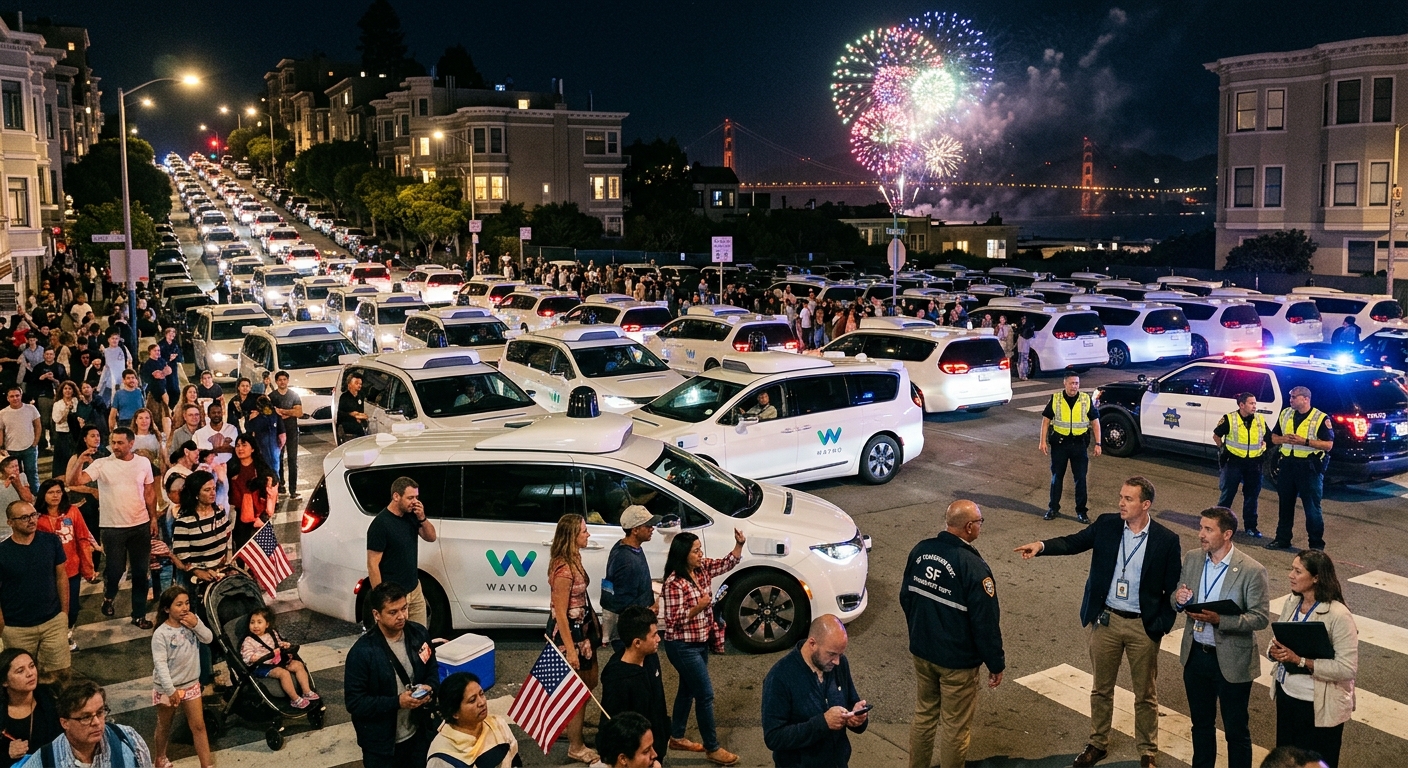
Further challenges emerged during a major Fourth of July fireworks event the following year, where over 30 Waymo vehicles became immobilized in crowded parking areas near the Golden Gate Bridge. This situation exacerbated traffic gridlock, blocked access routes, and created public frustration amid a surge of over 100,000 visitors. Reports indicated some vehicles ran out of charge while stuck, with one even observed driving through exploding fireworks, underscoring the difficulties AVs face in highly congested, unpredictable environments with significant human activity. These incidents collectively raise questions about the current capabilities of driverless cars to operate reliably and safely under both extraordinary and high-stress conditions, impacting public confidence in their widespread deployment.
Assessing Autonomous Vehicle Impact on Emergency Response
Autonomous vehicles have repeatedly presented challenges for San Francisco’s emergency responders, raising critical questions about their interaction with essential public services. Fire department reports have documented at least 31 instances since April 2025 where Waymo and other robotaxis obstructed emergency operations, delaying critical access during urgent situations. In one notable incident, verbal instructions to switch a Waymo vehicle into manual mode proved ineffective, and a gear selector malfunction caused the car to move forward instead of reversing, potentially worsening an emergency response scenario. Such occurrences have prompted heightened scrutiny from federal and state regulators, who are now examining the adequacy of communication and control mechanisms between AV fleets and first responders.
These obstructions have led to significant concerns from first responders, who emphasize the urgency of ensuring AVs do not impede their ability to save lives. San Francisco Fire Department Chief Patrick Rabbitt has specifically noted an increase in traffic violations and instances where Waymo vehicles blocked access to fire stations, directly hampering emergency operations. The inability of AVs to consistently yield or respond appropriately to emergency vehicles or personnel creates a tangible risk, forcing city officials and AV companies to prioritize improved coordination and robust protocols for emergency preparedness. Addressing these issues is crucial for maintaining public safety and ensuring that the benefits of AV technology do not come at the cost of effective emergency services.
Understanding Autonomous Vehicle Safety Records and Collisions
The safety record of autonomous vehicles, particularly in complex urban settings, remains a significant point of public and regulatory concern, highlighted by several notable incidents in San Francisco. A multi-car collision in late 2023 involved a stationary, unoccupied Waymo vehicle being struck by a speeding Tesla, resulting in the first fatal U.S. crash featuring a fully driverless car, though Waymo was not held responsible. While the Waymo car was not at fault, its involvement in such a severe incident underscores the inherent complexities of AVs operating alongside human-driven vehicles and the challenges of assigning responsibility in multi-vehicle crashes. This event, alongside other collisions involving Waymo vehicles, contributes to the ongoing debate about the overall safety and readiness of autonomous technology for widespread adoption.
Beyond fatal incidents, Waymo vehicles have been involved in other collisions, such as an October 2024 incident where an SUV stopped at a red light resulted in minor injuries to passengers. The National Highway Traffic Safety Administration (NHTSA) mandates the reporting of all autonomous vehicle collisions, providing critical data for assessing the safety and impact of self-driving technologies. Since July 2021, Waymo’s vehicles have been involved in approximately 30 collisions resulting in injuries, underscoring the ongoing need for stringent safety protocols and transparency. These incidents, while not always the AV’s fault, highlight the continuous need for rigorous testing, software refinement, and clear regulatory frameworks to ensure public confidence in the safety of driverless transportation.
Navigating Regulatory Scrutiny and City Demands for AV Operations
San Francisco Mayor Daniel Lurie has emerged as a vocal advocate for stricter regulatory oversight of autonomous vehicles, emphasizing the need for robust operational capabilities that ensure safety under all conditions. Following incidents like the citywide power outage and the Fourth of July gridlock, Mayor Lurie has called for statewide standards requiring AV manufacturers to demonstrate reliable performance during both normal and extraordinary events. He has directly communicated with Waymo’s CEO, requesting the removal of their vehicles from city streets during major disruptions to prioritize public safety and first responder access. These demands reflect a growing consensus among city officials that voluntary measures are no longer sufficient given the expanding scale of AV operations.
In response to these challenges, the California Department of Motor Vehicles (DMV) enacted new regulations in mid-2024, empowering law enforcement to issue formal notices of noncompliance directly to AV manufacturers when vehicles break traffic laws or malfunction. This strengthens enforcement mechanisms and provides city agencies with a more direct avenue to address operational issues. Furthermore, San Francisco launched the Street Safety Initiative under Executive Directive 25-06 in December 2025, adopting the U.S. Department of Transportation’s Safe System Approach to improve roadway safety. This initiative establishes a working group co-chaired by the San Francisco Municipal Transportation Agency (SFMTA), Department of Public Health, and Police Department, aiming to align strategies and enhance collaboration to reduce traffic injuries and fatalities, and better integrate AVs into the city’s broader mobility goals.
Despite San Francisco city officials lacking direct permitting authority over AV companies—with oversight primarily resting with the California Public Utilities Commission and the DMV—they are actively pressing the state for stronger controls and clearer operational standards. The city’s decade-long engagement with AV technology, highlighted by events like the 2026 Autonomous Vehicles and the City Symposium, underscores the importance of building an automation ecosystem that prioritizes safety, regulatory clarity, and seamless integration with existing transit systems. This sustained advocacy aims to balance technological innovation with the critical goals of public safety and urban mobility, ensuring that AV deployment aligns with the city’s Vision Zero objectives and enhances, rather than impedes, the urban environment.
Waymo’s Commitment to Operational Improvements and Safety
Following a series of operational challenges in San Francisco, Waymo has committed to implementing fleet-wide software updates and enhancing its emergency response protocols to improve safety and reliability. The company is refining its software confirmation protocols to provide vehicles with more specific context about regional power outages, enabling them to take more decisive and safer actions, especially at intersections with dark traffic signals. This proactive approach aims to prevent future incidents where vehicles become stranded or contribute to congestion during widespread disruptions. Waymo’s ongoing efforts to update its technology demonstrate a commitment to learning from real-world incidents and continuously improving its autonomous driving system.
Waymo has also increased its engagement and training initiatives with first responders and established clearer communication channels with emergency management agencies, including the San Francisco Department of Emergency Management (DEM). The company has embedded a staff member within the San Francisco Emergency Operations Center to facilitate real-time collaboration and expedite response efforts during crises. Furthermore, Waymo’s roadside assistance team plays a crucial role in clearing stranded vehicles, with some able to navigate away once conditions improve, while others require towing. These measures reflect a concerted effort to foster better coordination with city officials and emergency services, aiming to ensure that AV operations support, rather than hinder, public safety during emergencies.
Beyond these immediate responses, Waymo has issued recalls to update software in thousands of vehicles, addressing specific issues such as illegal school bus passing in Texas and navigating construction zones in the Bay Area. These recalls underscore Waymo’s ongoing commitment to improving safety and operational reliability across its service regions, indicating a continuous process of identifying and rectifying software deficiencies. By proactively addressing these challenges through technological and procedural adjustments, Waymo seeks to build greater confidence in its autonomous vehicle technology among regulators, city officials, and the public, paving the way for more seamless integration into urban environments.
Addressing Public and First Responder Concerns About Driverless Cars
The expansion of autonomous vehicle operations in San Francisco has elicited significant concern and criticism from various community members and stakeholders, particularly first responders. Firefighters have been vocal about the challenges posed by self-driving cars, citing numerous instances where these vehicles blocked emergency routes and delayed critical response times, directly impacting their ability to reach incidents swiftly. Sam Gebler, president of San Francisco Firefighters Local 798, emphasized the urgent need for AVs to operate safely in emergencies, stating that roads cannot be blocked when lives are at stake. These concerns highlight a critical friction point between technological advancement and the practical realities of urban emergency services.
Community frustration extends beyond emergency access to include broader public safety concerns and traffic management issues. Online video footage, for example, showed dozens of Waymo vehicles stationary on city streets following a major fireworks display, contributing to heavy traffic congestion and raising questions about the readiness of San Francisco’s infrastructure to accommodate driverless cars during high-traffic events. Public comment sessions at city meetings have frequently featured opposition to Waymo, with many residents expressing concerns over safety, accountability, and the overall impact of AVs on urban mobility. This widespread public sentiment underscores the need for AV companies and regulators to address these issues transparently and effectively to build trust.
City officials, led by Mayor Daniel Lurie, have responded by initiating a higher level of interagency coordination and oversight, committing to work closely with the fire chief and Department of Emergency Management to ensure first responders receive necessary support from AV firms. While Waymo has acknowledged these issues and taken steps to improve its operations, including increased engagement and training with first responders, the ongoing dialogue between the city, emergency services, and autonomous vehicle operators underscores the complexities of integrating driverless technology into urban environments. Resolving these concerns is crucial for the successful and safe deployment of autonomous vehicles, requiring a collaborative approach that prioritizes public safety and efficient urban functioning.
The content is provided by Jordan Fields, 12minread