
Understanding the Government’s Shift to Manchester
The UK government is actively pursuing a significant decentralization initiative, aiming to relocate key civil service functions and political decision-making from London to Manchester, a move encapsulated by the establishment of “No 10 North.” This strategic shift is part of a broader agenda to rebalance government power, reduce its concentration in the capital, and stimulate regional economic growth and devolution across the UK. The initiative directly addresses longstanding disparities between the North of England and London, signaling a tangible commitment to the “Levelling Up” agenda.
This relocation builds upon a historical push for administrative decentralization, which has seen renewed commitment in recent years to bring government closer to the regions it serves. While previous attempts at strengthening regional governance faced challenges, the current government has reiterated its intent to move senior civil servants and decision-making roles outside London to foster better responsiveness and address economic inequalities. The creation of No 10 North in Manchester represents a concrete step in this direction, aiming to become a vital hub for transferring influence from Whitehall and Westminster to regional authorities, with a particular focus on local growth and development.
Relocating Key Departments and Personnel
The establishment of No 10 North involves a strategic transfer of teams from several major government departments, including the Treasury, the Cabinet Office, and the Ministry of Housing, Communities and Local Government. These departments are notably led by ministers with strong ties to constituencies in the North of England, underscoring the regional focus of this initiative. The relocation aims to shift operational responsibility for devolution and local economic growth policies to Manchester, while core strategic functions will largely remain within the London-based departments.
To facilitate this move, the government is offering comprehensive relocation packages designed to encourage Whitehall officials to voluntarily transfer to Manchester. Beyond moving existing staff, there is a clear objective to recruit approximately 300 new employees directly from Greater Manchester and the wider northern region within an 18-month timeframe, fostering local talent within the civil service. Furthermore, a significant number of personnel from Andy Burnham’s former mayoral team at the Greater Manchester Combined Authority are expected to integrate into the No 10 North unit, strengthening the regional administrative presence and expertise.
This initiative aligns with a broader government target to reduce the concentration of civil servants in London, where a disproportionate number of senior roles are currently based. While the overall percentage of civil servants in London has seen a recent decline, the goal remains to cut London-based positions by 12,000 across the civil service to achieve a more balanced geographical distribution. Experts emphasize that for this change to be truly substantive rather than merely symbolic, it is crucial that politically important and senior policy roles are among those successfully relocated outside the capital.
Establishing No 10 North: Location and Security
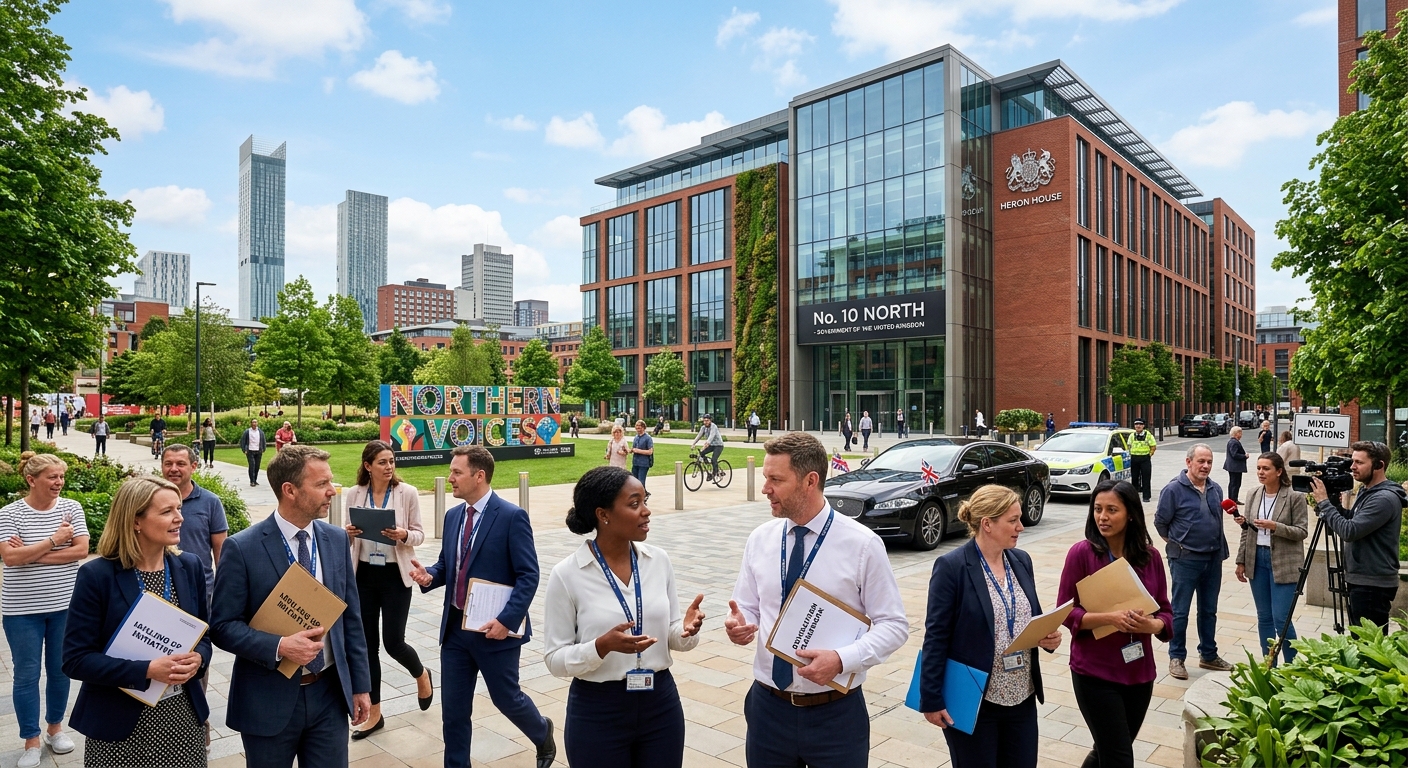
No 10 North is designed to serve as a new branch of Downing Street, strategically located in Manchester to enhance government presence outside the capital and drive regional economic development. Its initial operations are based in Heron House, a central Manchester building that also houses GCHQ offices and is already equipped with stringent security measures, including specialist police officers and a 24-hour armed police presence. This interim headquarters provides a secure and functional base while the long-term facility is under development.
The planned permanent site for No 10 North is the Manchester Digital Campus, currently under construction on a brownfield site in the city’s New Islington area, with an anticipated completion by 2032. This purpose-built government “Digital Campus” is envisioned as a modern hub that will attract new hires from across the North of England, further decentralizing government roles and promoting regional growth. While early architectural reviews of the campus designs have been mixed, the aspiration is for the final No 10 North facility to possess a distinctive appearance that reflects Manchester’s civic status and its role in national governance.
Security considerations are paramount for No 10 North, necessitating the replication of the robust protections found at Downing Street in London. This includes planning for bomb-proof infrastructure, advanced scanning stations, and continuous armed police patrols, measures that raise significant questions about the practicalities and planning involved in establishing such a high-security prime ministerial base outside the capital. Local police forces have indicated their readiness to collaborate with relevant government departments to implement these essential security arrangements as the project progresses, ensuring the safety and operational integrity of the new northern hub.
Assessing the Broader Impact and Public Reception
The relocation of Whitehall officials to No 10 North is projected to have a multifaceted impact on both government operations and regional development, particularly by shifting strategic decision-making powers related to devolution and local economic growth. This move is expected to generate significant economic benefits for Manchester and the wider region; government programs estimate that relocating 1,000 jobs can inject approximately £30 million into the local economy through increased footfall and staff spending. Manchester, alongside Salford, is thus positioned to become an even more prominent cultural and administrative hub, reigniting discussions about the distribution of major institutions and economic vitality across northern cities.
However, the government acknowledges that simply relocating personnel may not be sufficient to resolve deep-seated regional inequalities without the accompanying transfer of meaningful powers and resources to regional bodies. Experts and commentators have cautioned that without moving senior policy roles and politically important positions, the initiative risks being perceived as largely symbolic rather than a substantive shift in governmental influence. This perspective highlights the importance of ensuring the relocation is supported by clear policy frameworks and robust funding commitments to avoid a perception of gestures lacking real power shifts.
Public and media reactions have reflected both enthusiasm for Manchester’s enhanced civic status and a degree of skepticism regarding the practical impacts of decentralization. The announcement has reignited long-standing debates about the future of regional governance and the equitable distribution of political capital across the UK. While the initiative is widely seen as an important step in rebalancing the country’s administrative geography, ongoing scrutiny will focus on whether it delivers genuine empowerment and tangible benefits for the regions, or if it primarily serves as a visible but limited commitment to the “Levelling Up” agenda.
Long-Term Vision and Operational Commitments
The long-term vision for No 10 North is centered on its permanent establishment at the new government “Digital Campus” in Manchester’s Ancoats area, which is slated for completion by 2032. This campus is envisioned as a central, modern hub for government operations in the North, designed to embody a contemporary approach to regional governance and economic development. To support this, a recruitment strategy blueprint, developed by the Re:State think tank, emphasizes attracting new hires from across Greater Manchester and the wider North of England, aiming to embed local talent and regional representation within the government structure.
In parallel with physical infrastructure plans, the government has outlined significant organizational changes intended to bolster the establishment and efficient operation of No 10 North. These reforms include the restructuring of certain Cabinet Office functions and the relocation of responsibilities to new agencies, such as OneGov, which will centralize human resources activities like pensions, recruitment, and security vetting. The commitment to offering generous relocation packages for civil servants moving from London to Manchester underscores the government’s intent to implement the No 10 North initiative swiftly and effectively, integrating local economic growth policy and regional empowerment as a key driver of the UK’s economy and devolution agenda.
Ongoing security considerations remain a critical component of No 10 North’s development, with Greater Manchester police having acknowledged the proposals and expressed their willingness to collaborate with government departments on necessary security arrangements as plans progress. Formal details regarding these organizational and security changes are anticipated to be announced in forthcoming parliamentary sessions and through ongoing government appointments. These future developments will be crucial in demonstrating the sustained commitment to this significant rebalancing of the UK’s administrative geography.
The content is provided by Sierra Knightley, 12minread